Natural environment teaching tends to generalize better than isolated drills because the skill is practiced in the context where it will actually be needed. A child who learns to request a break at a table may not transfer that skill to a noisy gym. A child who learns to request a break in the noisy gym usually does.
Structured Teaching Trials
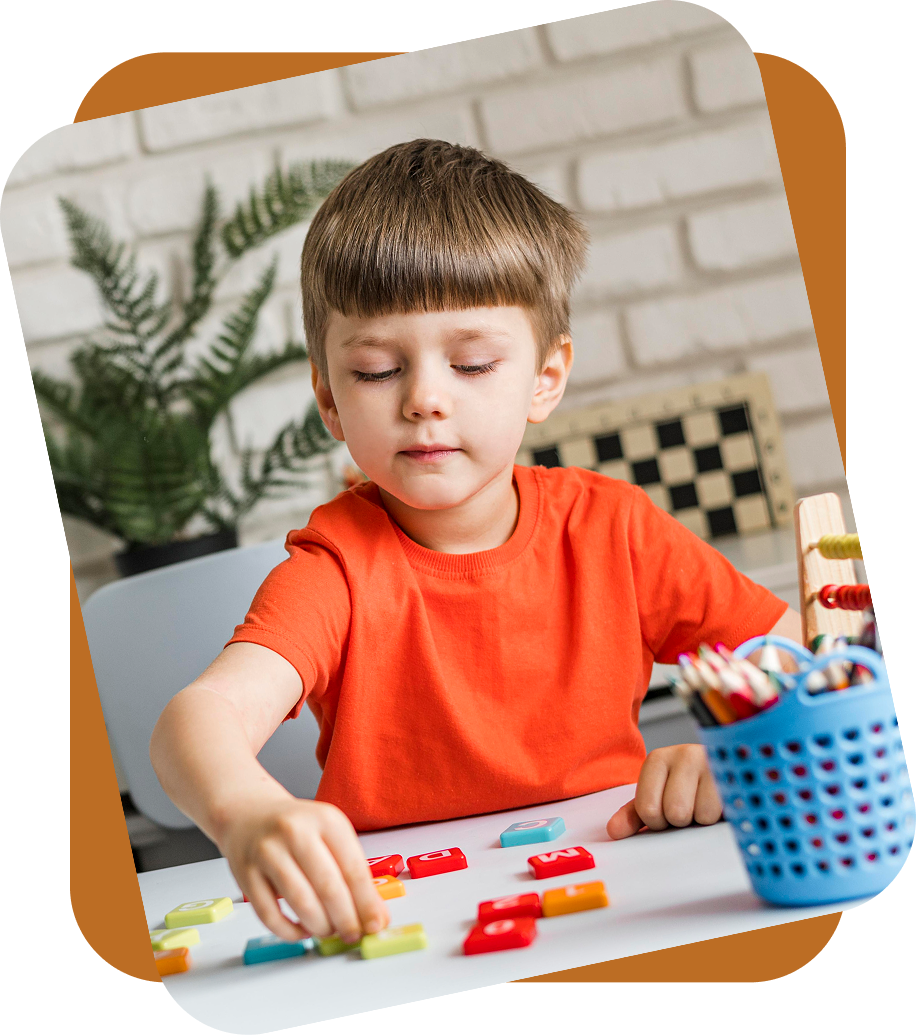
Some skills genuinely benefit from repetition in a controlled format: matching, early receptive language, imitation, letter and number identification, safety responses. These are taught in short, fast, high-reinforcement sets rather than long grinding sessions.
The best structured teaching does not look grim. It looks quick and upbeat, with the child earning access to something they care about, and it stops before frustration sets in rather than after.
Breaks, Movement, and Regulation
Breaks are scheduled, not just granted after a hard moment. This is deliberate. If the only reliable way to get a break is to become distressed, a child learns exactly that. When breaks are built into the schedule and available on request, the child learns something far more useful: that asking works.
Sensory and movement activities are woven throughout the day rather than saved for the end. Swings, crash pads, obstacle courses, deep pressure, and simple outdoor time all show up on the schedule for children who benefit from them.
Communication Runs Through Everything
There is rarely a standalone communication hour. Communication work happens continuously, in whatever modality the child uses, whether that is spoken words, a speech-generating device, sign, or picture exchange.
We regularly see families worry that using a device will slow down speech. The research and our own experience point the other way. Giving a child a reliable way to be understood tends to reduce frustration and increase communication attempts across the board. A child who can finally tell you they want the blue cup, not the green one, has less reason to melt down about the cup.
Progress here is often measured in unglamorous increments. Moving from a single-word request to a two-word request. Getting a spontaneous comment that nobody prompted. Learning to say no in a way that gets respected, which is a genuine goal and not a minor one.
Lunch, Snack, and Daily Living Skills
Mealtimes are working time, though it rarely feels that way to the child. Opening containers, requesting more, washing hands, wiping a spill, sitting with peers, tolerating an unfamiliar food on the same plate as a preferred one: all of it is programmable.
Feeding goals are approached slowly and without pressure. Forcing a bite has never produced a child who enjoys eating. Reducing distance between a child and a new food, then encouraging touching it, then smelling it, then tasting it, over weeks, produces far better outcomes and keeps mealtimes from becoming something to dread.
Toileting, dressing, and hygiene routines are practiced during natural moments in the day rather than staged artificially. Parents are looped in on these goals closely, since consistency at home is what makes them stick.
Peer Time and Social Groups
Center-based programs offer one thing home services cannot easily replicate: other kids.
Social groups are usually structured around a shared activity such as a cooperative game, an art project, or a snack club. Adults stay close and support the interaction without narrating over it. Goals vary widely by learner: initiating with a peer, staying in a shared activity for a set duration, handling losing a game, joining an ongoing activity, or repairing a small conflict.
This is where progress becomes visible to parents in a way that data sheets sometimes do not capture. In our groups, we have watched children who spent their first month watching from the edge of the room end up leading the game by spring.
What the Supervising BCBA Is Doing All Day
Live Supervision and Coaching
The BCBA is not in an office reviewing paperwork. They are moving between rooms observing sessions, modeling procedures, and giving technicians feedback in the moment. If a prompting sequence is not working, it gets corrected that hour, not at a monthly meeting.
When a Program Changes
Programs are living documents. A goal that produces three weeks of flat data gets reworked. A skill mastered early gets replaced with the next one in the sequence. Reinforcers get rotated when a child loses interest, which happens constantly and is completely normal.
Assessments are updated on a regular schedule to keep goals aligned with where the child actually is, and treatment plans are revised with family input before they are submitted for
insurance authorization.
Hard Moments and How They Are Handled
Not every hour goes smoothly, and any provider claiming otherwise is not being straight with you.
When a child becomes distressed, the priority is
safety and de-escalation, not compliance. Demands are reduced, the environment is adjusted, and the adult stays calm and close without escalating. Afterward, the team looks at what happened before the moment to understand what the behavior was communicating. Almost always, it was communicating something reasonable: this is too hard, I need a break, I do not want to stop, I do not feel well, I could not tell you what I needed.
The long-term work is teaching a more effective way to communicate that same message, then honoring it when the child uses it. A functional communication response that adults ignore will not last a week.
The End-of-Day Handoff
The last few minutes with a parent are among the most valuable of the day. A good handoff covers what the child worked on, what went well, anything difficult and what preceded it, and one specific thing the family can practice at home that evening.
"He had a great day" is not a handoff. "She used her device to request a break twice without prompting, and she did it during the loudest part of group, which is new" is a handoff. Parents can do something with the second one.
How Clinic Days Differ by Age
Early Learners
For toddlers and preschoolers, days are shorter, play-based, and heavy on communication,
joint attention, tolerating transitions, and early self-help skills. Sessions follow the child's energy closely, and rest or quiet time is built in. Families in this age range often coordinate clinic services with early intervention ABA therapy supports.
School-Age Children
Older learners typically handle longer blocks and more structured academic-readiness work. Goals shift toward independence: following multi-step directions, managing personal belongings, self-advocating, navigating peer conflict, and building routines that transfer to a classroom. For children attending school part of the day, school-based ABA therapy can extend the same goals into the school environment.
How Clinic Days Fit Into the Rest of the Week
Center-based sessions are one piece of a larger plan. Many families combine our ABA therapy clinic with in-home ABA therapy so that skills built in a structured setting get practiced where the child actually lives, in real routines like bedtime, mealtimes, and getting out the door in the morning.
Parent training is the connective tissue between the two. Children spend far more hours with their families than with any clinical team, and the families who make the fastest progress are the ones who learn the strategies themselves rather than outsourcing them.
Over school breaks, a summer ABA therapy program helps prevent the skill regression that long unstructured stretches can bring, while keeping the day social and enjoyable rather than clinical.
Conclusion
A clinic day is not six hours of drills. It is a carefully sequenced mix of play, teaching, movement, meals, peer interaction, and rest, held together by data that tells the team what is working and adjusted continuously by a supervising analyst who is watching in real time.
What families should look for is not a fancy facility. It is whether the adults know each child well, whether the schedule respects how children actually function, whether communication is prioritized in whatever form the child uses, whether hard moments are handled with patience rather than pressure, and whether parents leave each day knowing something specific about their child's progress.
If a program can show you that, the room it happens in matters far less than what happens inside it.
Visit Our Clinic and See a Day for Yourself
Career Based Solutions provides clinic-based, in-home, and school-based ABA therapy to families in Virginia including
Charlottesville,
Harrisonburg, and
Arlington. Reading about a clinic day is useful. Seeing one is better.
Contact us to schedule a tour in our
Fredericksburg ABA clinic,
meet the team, and talk through whether center-based services are th right fit for your child.
Frequently Asked Questions